Business Dining
Choosing the Right Space for a Business Dinner
How I think about private, semi-private and quiet tables for executive and client dinners in Las Vegas — and the details I confirm before anything is booked.
By Jad Haidar · Updated September 2026 · 5-minute read
Privacy is a spectrum, and most business dinners do not need the most private option available. Here is when each of the three works, and what it costs you.
This is the right call when the conversation itself is the point — negotiations, sensitive internal discussions, board-level dinners. The question I ask first is how much of the conversation must remain private, and that answer usually settles the room. It also makes sense when the group is large enough that a dining-room table would put half the guests out of earshot. The trade-off is real: a private room can feel formal, and a room built for twenty can swallow a table of ten. I only push for one when the conversation or the size of the party genuinely needs four walls.
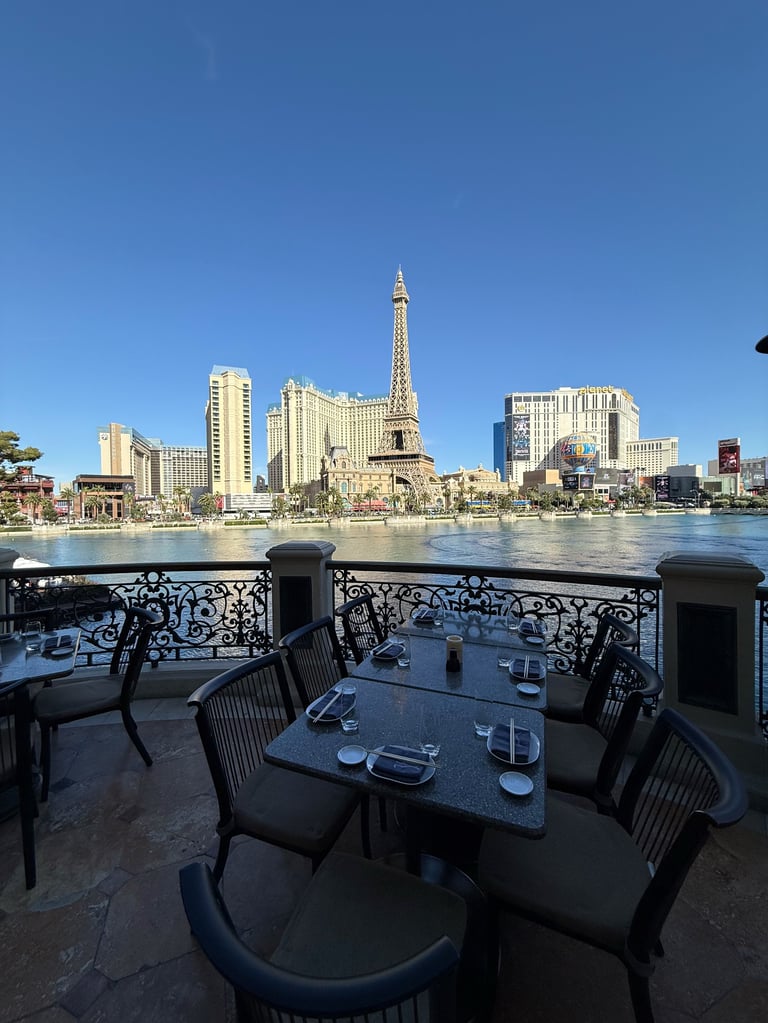
A curtained alcove, a raised section, a screened table, a corner of the terrace — the group gets its own defined space and more privacy than the main floor, though not the separation of four walls. For most client dinners this is the option I recommend. Guests still feel the energy of the restaurant, and the evening does not take on the formality of a conference room.
For four to six people, a table against a wall away from the kitchen pass and the service station can work better than a private space — particularly if the group would rather be part of the restaurant than separated from it. It also keeps cost down, since private-room minimums are often higher than the group would spend on food and beverage. What I look for is positioning, not prestige.
Once the room decision is made, most of the work is in the details around it. These are the questions I work through with the host before anything is confirmed.
A long single table works for a group that needs to talk as one. Several smaller tables work when guests do not all know each other. I confirm an exact count rather than a range, because twelve and fifteen people can change which room a restaurant can offer. I also ask whether the room has its own servers or shares them with the main floor, since that affects pacing.
For executive dinners a fixed menu is often the better tool. It makes the food cost and pacing easier to plan and removes the ritual of everyone reading a menu. Before I agree to one, I collect every restriction and allergy in writing — who does not drink, who does not eat red meat, who keeps kosher or halal, who prefers vegetarian — and send that to the restaurant so I know what it can accommodate. Some needs, kosher and halal in particular, may call for more than a menu substitution. A request raised at the table is much harder to solve.
A food and beverage minimum is a floor, not a final figure. I confirm the minimum, tax, any service charge or gratuity, and other applicable fees before giving the host an estimated total, and I send that estimate to the person paying before the date is held. The host should never be learning the number at the end of the night.
Guests rarely arrive together, especially during a convention when people come from different hotels and sessions. I confirm how the restaurant handles staggered arrivals, where the group will actually be seated, and who greets the first guest. If the group is coming by vehicle, I check the drop-off point rather than assuming it is the main entrance, and I build in realistic travel time for Strip traffic rather than map-distance time.
A business dinner rarely ends when the plates are cleared. The best conversations often happen in the twenty minutes after the meal, so I look at what is walkable — a lounge, a terrace, a quieter bar in the same property — rather than moving everyone into a vehicle.
Restaurants control their own rooms, availability, minimums, pacing and service. I can ask, confirm and plan around what they tell me, but the room and the service remain theirs to run.
During major Las Vegas conventions, many groups need dinner at similar times. Smaller rooms suited to executive conversations can book up early, so I start by understanding what each group needs before approaching restaurants.
When a client asks me to arrange several small dinners that week, I work through the same questions for each one before I make a single call. How many guests, exactly. Who is at the table and what has to be discussed. What time the last session ends and whether anyone is arriving that afternoon. Where each group is staying. Whether the conversation needs four walls or just a quiet corner. What the company is comfortable spending, all-in. And where the group should be able to walk afterward.
Only then do I approach restaurants, and I ask each one the same things: what space is genuinely available that date, what the minimum is and what tax and service add on top, how many people the room seats comfortably, the deadline to confirm headcount, how the kitchen handles a fixed menu with dietary restrictions, where a vehicle can drop the group, and the cancellation terms.
The reason to start early is not to secure something privileged. During a busy convention week the rooms that suit a small executive dinner are limited, and a group that waits chooses from what is left. Availability, minimums and terms belong to the restaurant, and I plan around what they can confirm.
Jad Haidar is the founder of All Set Vegas and a state-registered independent concierge with more than a decade of experience in Las Vegas hospitality, VIP services and group coordination.
The Blueprint covers planning within an agreed scope: room selection, seating and layout, fixed menus and dietary needs, minimums and the realistic all-in cost, arrival timing, transportation, and where the group goes afterward. It is pre-arrival planning, not on-site hosting.
If your dinner is one evening inside a larger trip, I cover how to plan it alongside the rest of the itinerary in my notes on coordinating group experiences.
Explore The Blueprint