Nightlife, Daylife & Dining

Why Table Placement Matters in Las Vegas

How position shapes a nightclub table, a dayclub cabana and a dining reservation — and why the most expensive option is rarely the right one

By Jad Haidar · Updated September 2026 · 6-minute read

Two tables at the same venue, at similar minimums, can create very different experiences.

A floor plan will tell you where a position sits and what it costs. It usually won't tell you what the position actually feels like once the space is full — whether the view of the DJ or stage is clear or blocked, how loud it gets, who walks past your group all night, how much room you really have, how quickly you can get to a bar, a restroom or the pool, and whether the arrangement actually suits the people sitting in it.

I've spent more than a decade in Las Vegas hospitality, and I handle every All Set Vegas engagement personally. Most of what determines whether a seating position works has nothing to do with how much it costs. It has to do with how a specific group wants to spend the hours in front of them — and that is a question a price list can't answer.

The most expensive placement is not automatically the best one. The right position depends on the group, the occasion, the priorities and how guests want to experience the room.

That applies across the trip, not just to nightclubs. A cabana, a daybed, a dining table and a nightclub booth are all versions of the same decision: where your group sits, and what that position makes easy or difficult.
What Placement Changes

Position affects the same handful of practical things regardless of whether you are booking a nightclub table, a dayclub cabana or a restaurant. These are the factors I weigh before recommending anything.

Sightlines and Orientation

What your group can actually see from where it sits — the DJ, the stage, the pool, the room, the view out a window — shapes how connected guests feel to what is happening. A position can be close to the action and still have its view blocked by a column, a speaker stack or a standing crowd.

Sound and Conversation

Seats closer to speakers, stages or production tend to feel more immersive. They also make conversation harder, and sometimes impossible without leaning in. Neither is better in the abstract — it depends on whether the group came to be inside the sound or to talk through the evening.

Foot Traffic and Boundaries

Entrances, bars, dance floors, restrooms and service paths all move people through a room. A position beside one of those lanes can feel less private and less comfortable, simply because strangers pass through or alongside your space all night. Positions set back from the main paths usually have clearer edges and fewer interruptions.

Space and Group Connection

A placement has to fit the actual guest count comfortably, and it has to let people interact without ending up in separate pockets. A position can be well located and still be wrong if the group is stretched across a space that is hard to share — which is one of the reasons group size and seating shape each other. I've written about that side of it in coordinating group experiences in Las Vegas.

Access and Movement

How easily guests can arrive, leave, reach the dance floor or the pool, and find their way back matters more over a long evening than it does in the first five minutes. A position that is awkward to reach feels awkward every time someone moves.


How Nightclub Placement Changes the Night

Nightclub seating tends to fall into a few broad types, and each one trades something for something else. None of them is universally better — they suit different groups.

Near the DJ or stage. Immersive, loud, and in the middle of the production. Conversation is difficult and the space around the table is usually busier. For a group that came for the music, this is the reason to be there.

Near the dance floor. Connects your group to the room's centre of movement without putting you directly under the speakers. Guests can drift onto the floor and back without a plan — which also means traffic past the table is constant.

Elevated or perimeter positions. Frequently the better sightlines in the room, with more of a view and more room to breathe. They are also further from the energy, which some groups notice immediately.

Tables near major walkways. Easy to find and easy to leave, but they sit in the path of everyone moving between the entrance, the bars and the floor. Privacy is the trade-off.

More separated or defined spaces. Clearer boundaries and a greater sense of your own area, usually at the cost of proximity to what is happening elsewhere in the room.

Which of those is right depends far more on the group than on the venue:

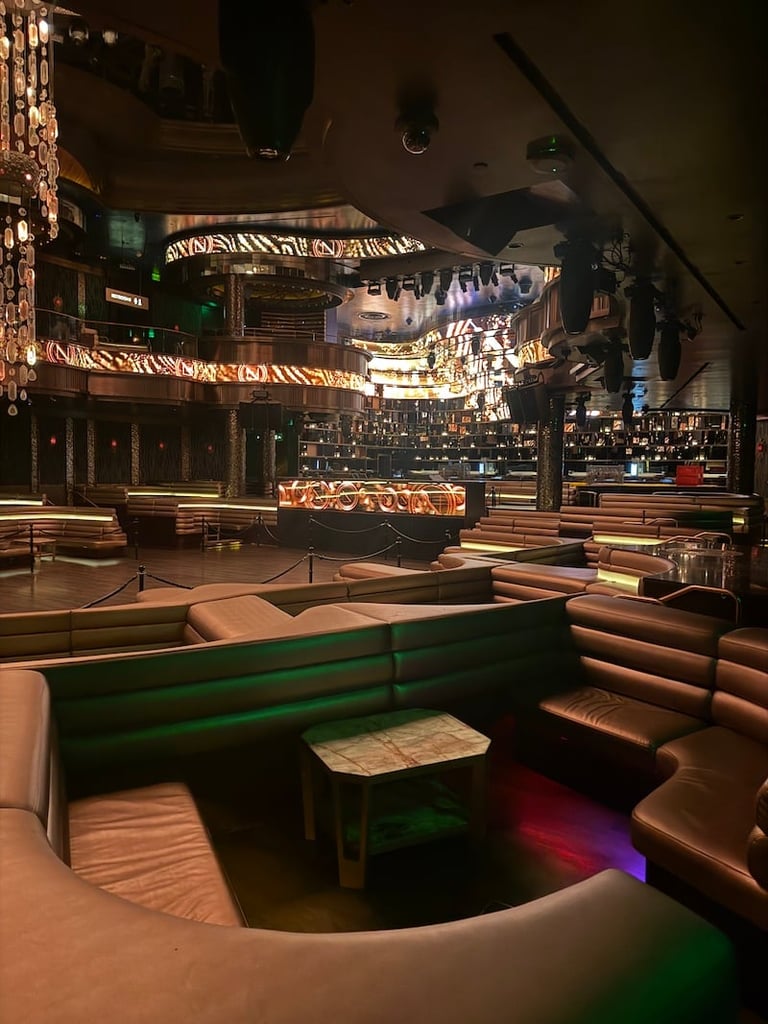
Interior of an upscale nightclub with curved green and brown leather booths, an illuminated stage with neon signage, and dramatic lighting
Where a group sits determines how much of the room it actually feels

Choosing a Daybed, Cabana or Bungalow

Daylife works differently from nightlife. A cabana or daybed isn't a seat for one evening — it's a base for several hours in the sun, and the group will spend most of that time inside the space rather than away from it. That makes some factors matter more than they would at night.

Sun exposure and shade. Some positions take direct sun through the afternoon while others sit in shade for most of it. Neither is better; both are worth knowing before committing, particularly with a mixed group.

Distance from the pool. A position beside the water makes it easy to move between swimming and sitting. A position set further back usually means more walking — and often more privacy and less crowd density.

Proximity to music and production. Closer to the DJ or stage means more immersion and more volume. Farther back, conversation becomes realistic without losing the atmosphere.

Walking distance to restrooms and bars. Over an afternoon, this affects the group more than people expect. It is also the factor guests most often overlook when looking at a pool deck on a map.

Crowd flow and boundaries. Paths between the entrance, the bar and the pool determine how often people pass through or beside the space. Positions along a main route feel busier; positions with a natural edge feel more defined.

Group capacity. A cabana that suits six comfortably may be crowded with twelve, and the difference shows up by the second hour rather than the second minute.

A poolside position typically offers convenience and immersion. A more removed cabana or bungalow can offer shade, a clearly defined space and easier conversation. Which one suits the group is a question about how those hours are meant to be spent — not about which option is superior.

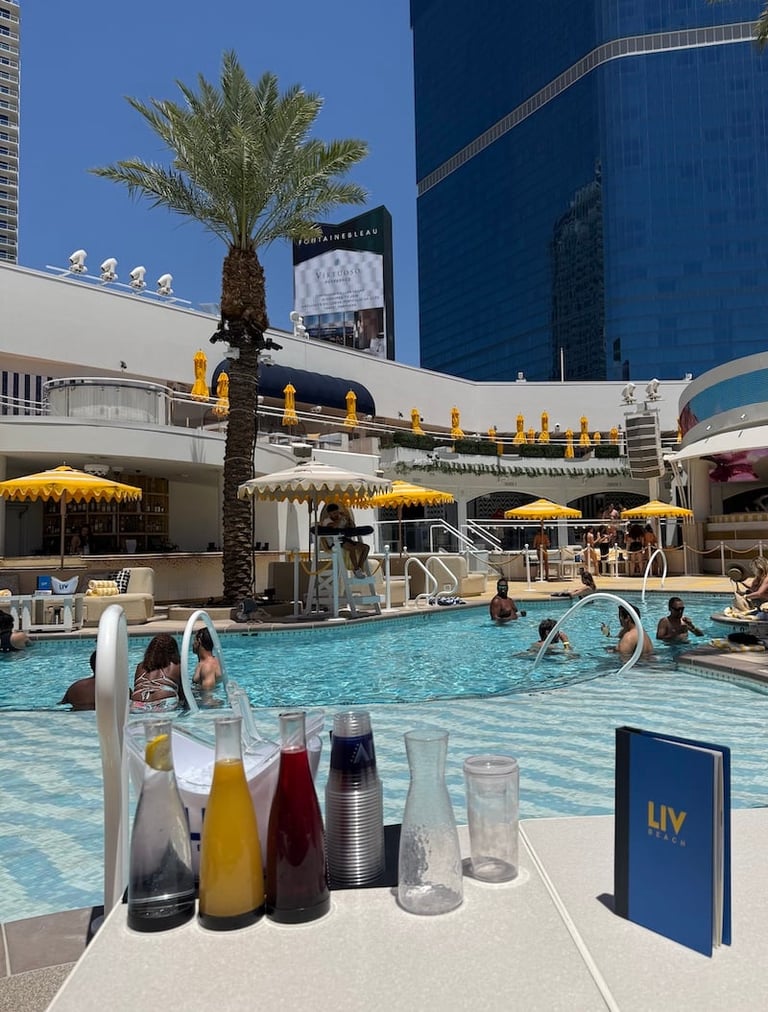
Poolside beverage setup at a luxury resort with blue water, yellow umbrellas, a palm tree, and modern high-rise buildings in the background
A dayclub position is a base for the afternoon, not a seat for an hour

Dining Tables Shape the Meal Too

Dining placement works on the same principles, though the factors carry different weight. At a restaurant, the meal is the event, so what matters most shifts toward how comfortably the group can actually sit and talk.

Noise is usually the first thing I think about. A room can be excellent and still be too loud for the conversation the table was booked for. Privacy and view matter depending on the occasion, as does proximity to entertainment or service areas — a table beside a service station or a pass is a different dinner than one set away from it.

Foot traffic and temperature are easy to overlook. A table near the entrance, or under a vent or beside a terrace door, can change how an hour and a half feels. And with a larger group, the seating arrangement determines whether everyone can be part of the same conversation or whether the table splits into two.

For a deeper look at how I weigh those variables — and why a restaurant can be excellent and still be the wrong room for a specific evening — see A Concierge's Perspective on Dining in Las Vegas.


Higher Price Does Not Always Mean Better Fit

Guests often read a higher minimum as a proxy for quality — assuming the most expensive position is also the best one. It is a reasonable instinct, and it is frequently wrong.

A premium price can reflect several different things: proximity to the action, how visible the position is, how many guests it holds, how much demand there is for that night, or simply how the venue has chosen to tier its pricing. None of those automatically make the position right for a particular group.

A larger table may be priced higher and still feel too spread out for a group of ten. A prominent position may be priced higher and still sit in the middle of a walkway. A position near the production may carry a premium and still be unusable for a business dinner.

Value is easier to judge against what the group actually needs:

Judged that way, a more modestly priced position is often the better decision — and sometimes a more expensive one is, because the group genuinely wants what it offers. Both outcomes are legitimate. What matters is that the choice is made against the group's priorities rather than against the pricing chart.


Questions Worth Asking Before You Commit

Most of the information you need is available before you pay anything — it simply has to be asked for directly. These are the questions I work through with clients:

Answers vary by venue, by room and by date — sometimes by night of the week. A policy that applied to one booking does not necessarily apply to another. These are questions to put to the venue, and the answers are worth having in writing before you commit. They are not questions I can answer on a venue's behalf.


A Placement Request Is Not Always a Guarantee

This is the part of the conversation worth being clearest about, because it prevents the disappointment that comes from a misunderstanding rather than a bad table.

What I can do is help clients understand the options, explain how different positions tend to function, and make sure the group's preferences are communicated clearly to the venue. That is a real contribution, and it is usually the difference between a plan that reflects the occasion and one that reflects whoever booked first.

What I cannot do is assign the position. The venue controls final availability and placement. Layouts change, demand shifts, and operational decisions are made on the night by the people running the room. I don't have authority over any of that, and anyone who tells you they do is describing something they can't deliver.

So it's worth knowing which of three things you actually have:

All three can be perfectly good outcomes. They are simply different, and the difference should be understood before payment rather than discovered on arrival. Wherever possible, confirm pricing and placement directly with the venue before you commit.

Being clear about what is confirmed, what is requested and what is controlled by the venue is not a limitation. It is the basis of a plan you can actually rely on.

Poolside beverage setup at a luxury resort with blue water, yellow umbrellas, palm tree, and modern high-rise buildings in background

The experience extends far beyond the club


Booking Mistakes That Cost Guests The Most

Many disappointing nightclub experiences result from avoidable decisions — choices that are not about the venue itself but about how the booking was approached. Among the most common:

The reservation is only one component of the experience. Planning determines whether the night feels effortless — or like a series of problems being solved in real time.


Hidden Opportunity Costs

Poor table selection often creates problems guests never anticipated — consequences that only become apparent once the night is already underway and the opportunity to change course has passed.

Many guests leave a nightclub believing bottle service disappointed them. Often it was simply the wrong location — and the experience would have been dramatically different from a different table in the same venue.


The Value Of Independent Representation

One of the most overlooked decisions before committing to a nightclub minimum spend is choosing who represents your interests in that transaction.

An independent concierge evaluates recommendations according to the client's goals rather than venue incentives. The objective is not increasing spend. The objective is matching the right table to the right experience.

Independent guidance allows recommendations to remain centered on:

Importantly, an independent concierge can also advise a client not to book a particular table. Or not to book a particular venue. Or to change dates entirely. Or to choose another strategy altogether — perhaps one that doesn't involve a nightclub minimum spend at all. These are recommendations a venue-employed host is rarely positioned to make.

Independent representation means the recommendation is based entirely on the client's goals rather than on increasing minimum spend. The concierge has no incentive to upsell a table that doesn't fit. There is no quota to fill, no commission structure that rewards pushing a guest toward a higher spend bracket. There is only the objective of matching the right table to the right experience.

Sometimes the best recommendation is not to spend more. It's to spend smarter.


Bottle Service Is About More Than The Table

Great nightlife planning extends beyond the venue selection and the table choice. The surrounding details often determine whether the evening feels effortless or stressful:

These details rarely appear on a reservation confirmation. They are the invisible architecture of a well-designed night — and they often matter more than the bottle selection itself.


The Difference Between Buying Bottle Service And Designing A Night

Anyone can reserve a nightclub table.

Few people understand how room geometry, crowd flow, visibility, timing, service patterns, and guest psychology shape the experience. These are not abstract concepts — they determine whether the evening exceeds expectations, meets them, or falls short.

Bottle service is not simply a purchase. It is the design of one of the most memorable evenings of a trip. The table quietly determines whether the experience feels effortless and immersive — or whether the group spends the night wondering what they're missing.

That's why the most memorable Las Vegas nights aren't built around the most famous nightclubs. They're built around thoughtful choices that make the entire experience feel intentional — from the first cocktail to the final departure.

"People rarely remember the bottle they ordered. They remember where they spent the night."

People believe they are purchasing bottle service. In reality, they are choosing where one of the most memorable nights of their trip will unfold. The right table quietly elevates the experience. The wrong one is remembered for all the wrong reasons.

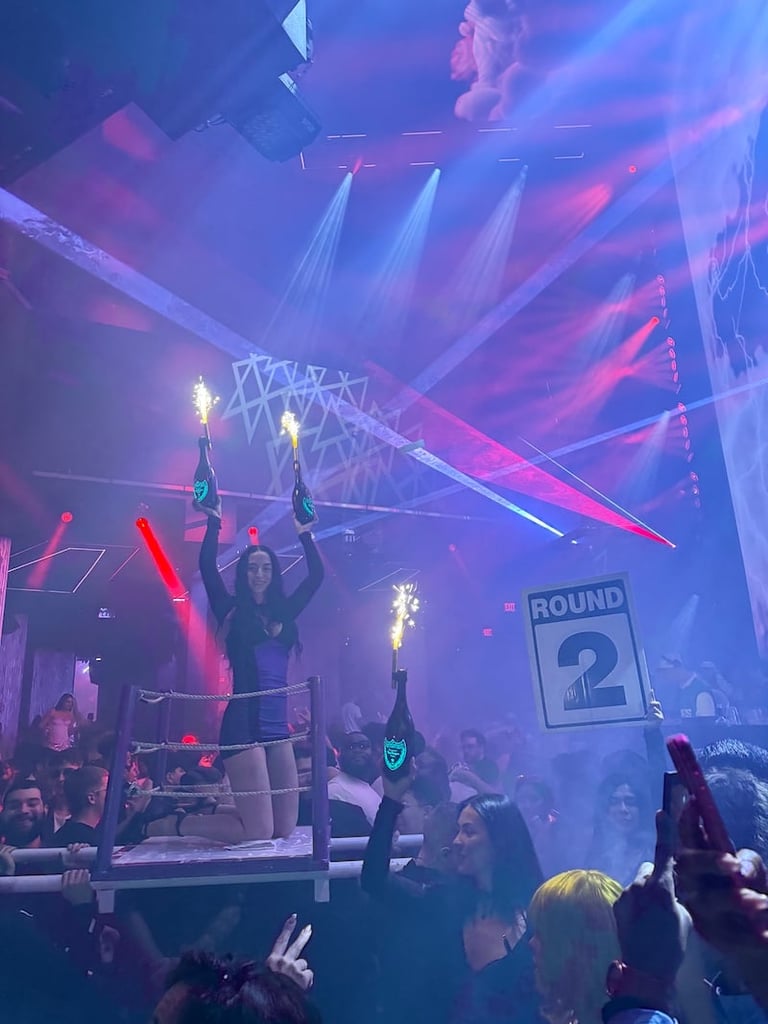
Nightclub stage with performers on elevated platform, blue and pink laser lights, round 2 sign, and crowd dancing below

The right table places you at the center of this

Planning A Night Worth Remembering?

Every recommendation at All Set Vegas is tailored to your group dynamics, preferred atmosphere, occasion, budget, and expectations. Because choosing the right nightclub is only the beginning. Choosing the right table — and having someone independently represent your interests before committing to a minimum spend — is what transforms bottle service into an unforgettable experience.

Request Personalized Nightlife Guidance Contact

Further Reading

Services Venues Reviews Our Philosophy Why Table Placement Matters Dining Guide Best Restaurants for Conversation

The Difference Between Buying Bottle Service And Buying Confidence

On the surface, bottle service appears to be a transaction. Guests believe they are purchasing alcohol and seating. They arrive, they spend, they leave.

But in reality, what guests are actually purchasing is far more meaningful:

The bottles are secondary. They always were. What guests are truly purchasing is the confidence that one of the most important nights of their trip will unfold exactly as they imagined — and that every detail has been considered by someone who understands how these rooms actually work.

Luxury isn't measured by the bottle on the table. It's measured by how effortlessly the evening unfolds around it.


Frequently Asked Questions

Is bottle service worth it in Las Vegas?

How do I choose the best VIP table?

Does the table location really matter?

Can a cheaper table provide a better experience?

What is included in bottle service?

How much should I budget after taxes and gratuity?

How early should I reserve bottle service?

Should I use an independent VIP host before booking?